


Joshua Boone and Nacho Arenas Break the Silence on Blow the Horn

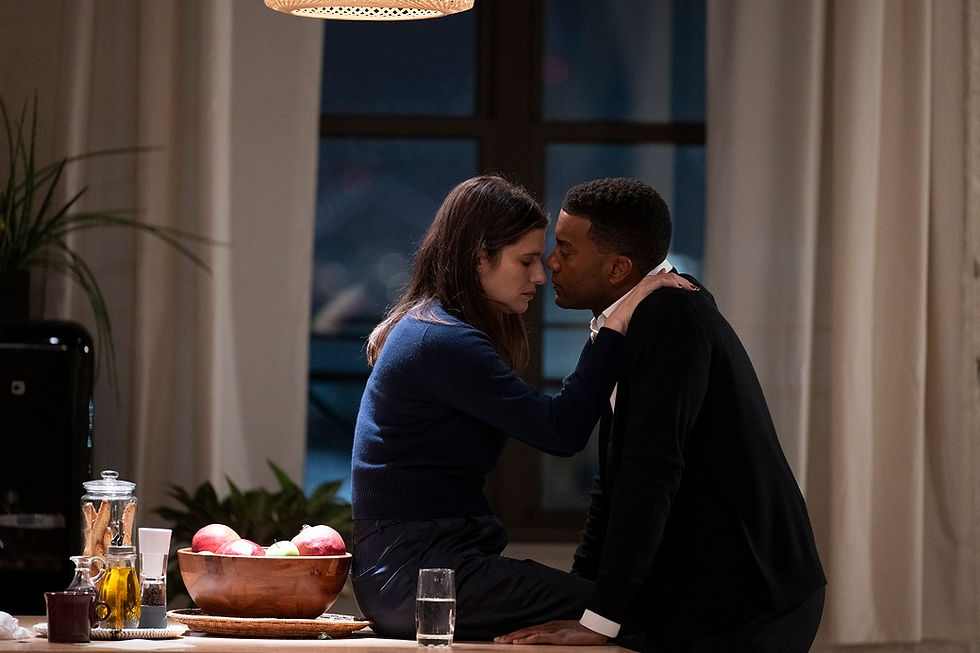
Joshua Boone and Nacho Arenas
Break the Silence on Blow the Horn
By Jay S. Jacobs
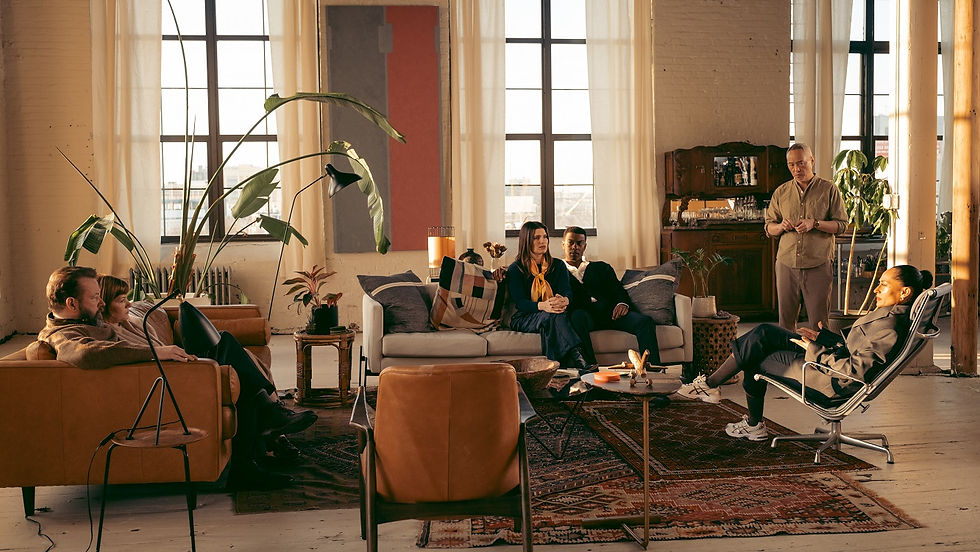
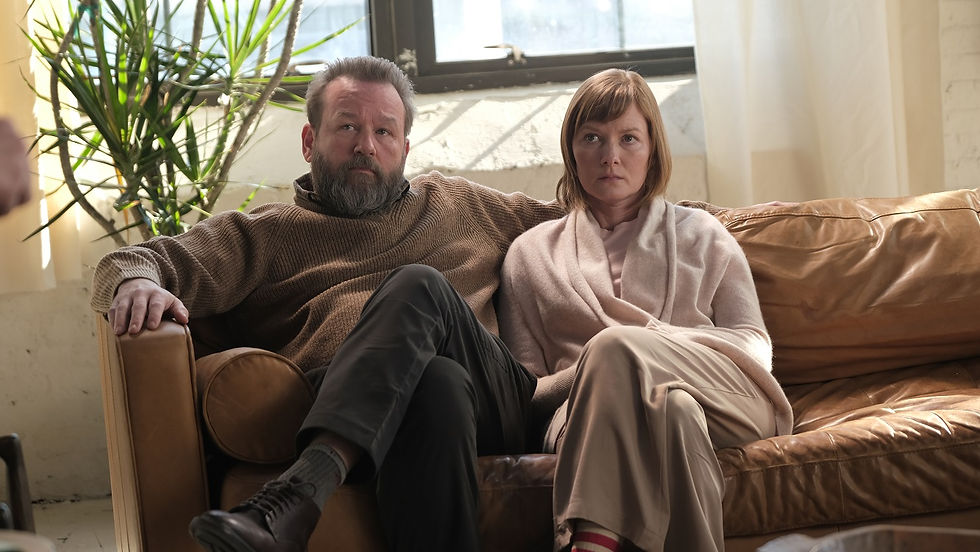
Three diverse couples, all strangers, all at different points in their personal relationships, are gathered together by their relationship counselor (somewhat tricked – all think they are going for private therapy). The counselor suggests a rather revolutionary idea – she will not be a part of the session, but she wants the three couples to do a variation of group therapy, to discuss their deepest darkest secrets with people who they’ve never met. Because everyone will be sharing, they will all learn from each other.
The analyst leaves a series of numbered, closed envelopes containing prompts they must open and openly analyze together. These envelopes direct them to discuss the following: “Initial Presentation & Dynamics” (introducing themselves and how they met, and what their relationships are now), “Jealousy & Trust,” “Sexuality & Passion,” “Parenting & Raising Children,” “Financial Conflicts & Hidden Vices,” “Infidelity & Deception” and “Control & Power Imbalances.” After they finish each envelope, they have to ceremoniously blow a horn (thus the title of the film) to move on to the next subject.
Needless to say, these subjects inspire some very touchy discussions. It’s the type of therapeutic exercise that can be helpful in theory, but wildly combustible in practice.
This is the concept behind the new film Blow the Horn, the directing debut by longtime writer and producer Nacho Arenas. The film is based on an Argentinian play – Baja Terapia by Matias del Federico – and takes an incisive look at relationships and communication in the modern world, taking on such hot-button topics as sex, substance abuse, gambling, physical and mental abuse and control.
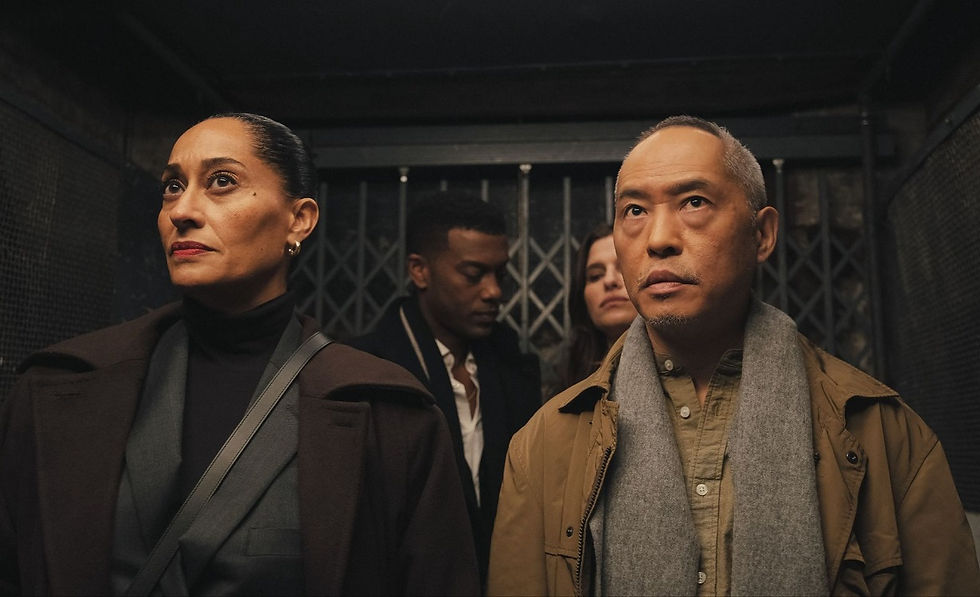
Blow the Horn is an ensemble piece full of intriguing talent. The six-member cast features such interesting actors as Tracee Ellis Ross (Black-ish, American Fiction), Ken Leung (Lost, Industry), Lake Bell (Boston Legal, In a World…, The Chair Company), Joshua Boone (A Jazzman’s Blues, 2024 Tony nominee for the musical The Outsiders), Wrenn Schmidt (For All Mankind, Nuremberg) and Dallas Roberts (The Walking Dead, Tulsa King).
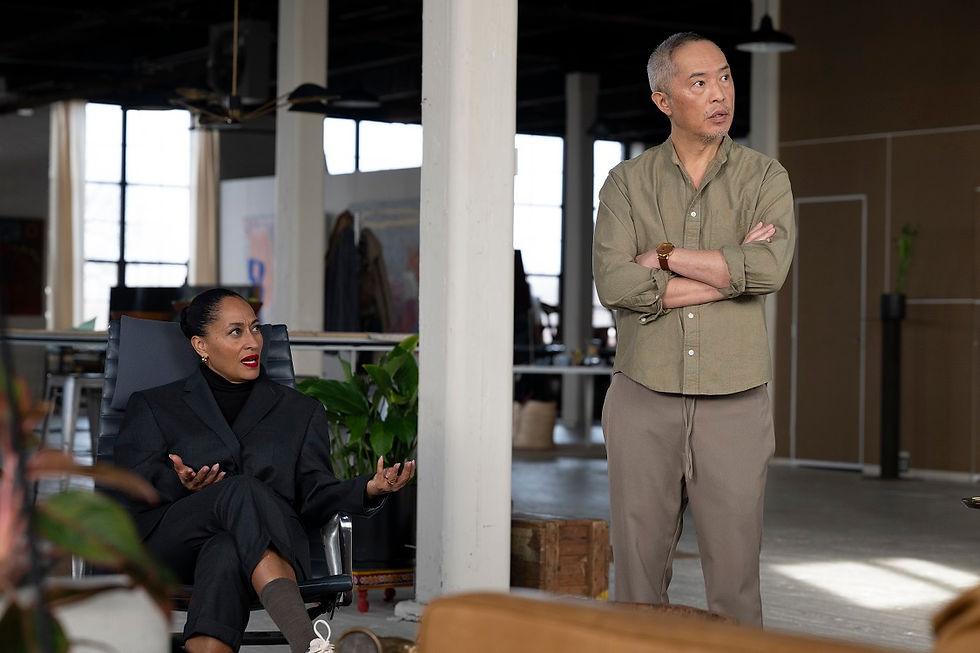
The film takes place almost completely in a huge funky city loft apartment (presumably the counselor’s own apartment), with essentially only these six people fleshing out the entirety of the story. The counselor calls in early on, but we never hear her voice. There is a policeman who has a single line of dialogue toward the end, and there are a few other extras in the background, but for the most part we are locked in the room together with these three couples and experiencing their analysis together.
About a week before Blow The Horn has its premiere at two film festivals – the Woodstock Film Festival (October 17) and the Newport Beach Film Festival (October 20) – I sat down with co-star Joshua Boone and writer/director Nacho Arenas to discuss their film.
Nacho, why did you feel that Baja Terapia would make a good film?
Nacho Arenas: When I first read Matias del Federico’s Argentine play, I just felt like the power dynamics that were shown and displayed were things that were very relatable to me. They were basically tapping on universal themes, on communication, compromise, relationships. I thought that it would be a fun challenge to adapt it from a play into the screen. That was the biggest thing for me, to translate a Latin American play into something for North American audiences and eventually world audiences.
Joshua, were you familiar with the original play before receiving the script for the movie?
Joshua Boone: Not at all. The script was my introduction.
What was the biggest challenge about translating the play to the big screen?
Nacho Arenas: Any time that you face challenges, especially adapting a play into film, you actually welcome them as you know possibilities to do something different. We knew it would be contained. We knew it was heavy in dialogue. To me the idea of collaboration with talent, with the cast, and allowing them to give some of that DNA that was true to them, to those characters. Then use the space that we got and the production design from Dina Goldman to actually allow us to breathe a little. Have the camera move from one spot to another, so that the audience would have a certain ability to not feel restrained to four walls. Then I made some changes with the play by introducing the dance sequence, having the actors at some point take a break and go outside, introducing a few other beats that also were approved by the author. It was interesting. Something Josh mentioned to me often during rehearsal and production, which I really loved hearing, was “honor the text.” So we tried to be as natural as possible while honoring the text.
Josh, you're mostly known for your theatrical work. Did the fact that this film was so theatrically based make it feel almost like home for you? And how is working on film different than being on stage?
Joshua Boone: It did make it feel like home. This being an ensemble piece definitely aided that too. Props and credit to Nacho for having rehearsal which drove that point home even more. This one was different in that it's one location and six people in pretty much every scene, every shot. Film and theater storytelling at its foundation is the same, but of course the technical aspects differ. This one was challenging in that you have five scene partners in every scene, which also aids the fun and play at your disposal. Especially because I was coming out of a theatrical production at that time, it definitely felt at home and like a natural transition to this project. We had a good time with it.
Was that right after you did The Outsiders?
Joshua Boone: We were rehearsing while I was still in Outsiders, yes.
I remember when I was in college, I had a writing professor who had said that the most difficult stories to tell were the ones that had a limited number of characters and took place in one or two settings. There are no distractions, and the audience sees everything that's being done, so it all has to have significance. Did the confined setting and limited cast change the way that you approach scenes, both as an actor and as a director?
Joshua Boone: For me, definitely. There's a thrill. I like one location. I like ensemble. As far as storytelling goes, for me it's always the more the merrier. Because the more people you have, the more things you can respond to, the more interactions you can have. Not only that, but the location we shot in, we had tall windows just to see light go day to night, and it was just beautiful. I'm one of those rare actors who enjoys every part of the process. Just to be in the midst and in the mix simultaneously with all the actors I was working with, with Nacho at the helm, it just provided an opportunity to grow, to stretch, to play, explore. Hopefully, the audience feels all of that exploration on the journey.
Nacho, how did that affect you as a director, having the limited cast and settings?
Nacho Arenas: Technically, you quickly get to understand the challenges of the eye lines. Also the camera movement, and basically the quick responses, and you make decisions. I really took the time to watch and to break down Sidney Lumet’s 12 Angry Men, which to me is a masterpiece. So you set the bar high. I'm nowhere near achieving that. However, the play in it was to challenge ourselves. Sometimes I decide to go and say, "Well, let's put the camera for seven-eight minutes on Josh, and don't leave him. Then we'll play around and we'll cut if we if we need to.” Sidney Lumet was great at basically saying “I'm going to stay with one character, and it doesn't matter who talks off screen.” So technically, the eye lines were important.
That’s true.
Nacho Arenas: We also, as Josh mentioned, found a space and we transitioned from day to night. We created an ellipsis [a time jump], which wasn't part of the actual play. Because it was tall windows, as you've noticed in the film, it becomes a challenge. It was a challenge for the director of photography to basically use the right lights. Obviously, the magic is that the audience should not feel anything different while they're watching, but to see the transition. At daytime, you had some days that were sunny outside and some other days that actually were rainy, and you have to keep the cinematography the same. Those were fun challenges. After that, it's again the playfulness of the actors. I think, to me as a director, I realized, especially going through the postproduction, that if I let the camera roll and if I were to reshoot the movie, I'd have a different result. I'd have different take. How grateful I am to have shot this film with the actors and the cast that I had. They could give me something different at any time, and that's something that as a director you have to embrace.
The film digs into jealousy, trust, infidelity, and power imbalances – a lot of topics that can really hit close to home. Did working on this project change the way that you think about relationships and communication?
Nacho Arenas: Josh, do you want to take this first?
Joshua Boone: I think for me, when I theorize about communication, if you will, I believe in truth and transparency. As we go on the journey of discovery, within the text and even exploration, it was very interesting to see and or hear why these couples had the issues that they did. What does it mean to come forward sooner, to share sooner, to find compromises earlier? Maybe you don't land at these junctures. That's me as a human. Then to explore what I experience day to day, the lack of communication, or what we withhold, what we don't say, the secrets we [keep]. A family member told me some years ago, “I don't have secrets, I only have history.” So many of us hoard our lives and put them in certain boxes. [We] call them secrets when those are the things that we should be offering to others, that tier of vulnerability and sharing if you will. I don't know if I'm answering your question. Like I said, I theorize about communication, and it's beautiful to have an example through this story of what it means to communicate properly, and maybe sooner and earlier on.
Nacho, did that affect you in a similar way?
Nacho Arenas: Again, the choosing of this play and then of making the film was something personal. But also while thinking about your question, I realized that you know relationships are basically Russian dolls. As you open the doll, there's a smaller doll, and then there's a smaller [one]. Those are problems. Those are layers. I wanted to create as a script something that was layered, and basically where the appearances would be never what you think they are. Cicero said something. I'm going to paraphrase it because I don't remember perfectly. What you see is not what it seems. Something like that.
I don’t remember a specific quote either.
Nacho Arenas: To me, that defines what we're trying to do because we hit on themes and beats that are very important. While always, for me, in the back of my head, when I was also editing with Sabine Hoffman, was understanding that this was entertainment. What you're trying to do is keep the audience on their toes as participants and try to move. You're in one room. There's a danger of becoming stale. To me, those relationships, those compromises, understanding the power dynamics in couples. When you tell the truth, and that could be hurtful. When do you deceive and when do you lie to protect someone? Then you hit things that hopefully the audience can relate to by either having witnessed, lived through it or done something else. Eventually you get to the theme without revealing anything to the twist, and you never see it coming. It's a gut punch that raises a different question. I want the audience to walk out of the screening, engaging with their partners or with friends, and discuss it.
The envelope structure was an interesting way of setting the whole pace and tempo of everything that happened. How did you decide on the pacing and the emotional escalation for each one of them?
Nacho Arenas: Do you know what? There's a certain natural [rhythm]. Sabine and I approached the process, trusting our guts and not staying too long. There are choices you need to make, whether it's with the pace and the editing or the music. Whether I was or we were successful at it, I don't know. The audience is going to tell me. I can tell you that there was a time in which I was debating even putting any type of score or music and letting the building actually have its own sounds, which we are when we're shooting. Josh will tell you that there are times in which we had to stop shooting because there was a radiator that became almost a character. There was the sound of the elevator. It was an old industrial building, and so there's a certain life that comes with it.
Yes, they all have their own little quirks.
Nacho Arenas: So to me, I approach the score and the editing as characters. We wanted to have a certain pace on the editing. I wanted to have a score that was minimal and that was kind of unsettling. As far as the pace, I think you have got to trust your gut. You got to know when you leave the camera on a character, or you just move and try to find another pace and try to move quickly. It's a delicate balance because you don't want to stay too long. Hitchcock said something that to me is true. He said, "Tease the audience, just don't upset them.” That was always in the back of my head. Trying to keep them on skates and not really knowing what couple and what could be the problem. Basically to finally deliver the knockout.
What do you think Blow the Horn says about the way that we communicate or fail to communicate in modern relationships?
Nacho Arenas: Actually, I would turn that question to you, who has seen the film. To the audience. It's not for me to [say]. I didn't do this film to pass judgment and to tell you how relationships, how partnerships work. It's more about, listen, do you recognize something? Would you change something about yourself? About friends? If you saw something, would you say something? It's more an invitation to this rather than me trying to tell you how relationships work and how compromises should be established. I'm 28 years into my marriage, and every day I'm learning something that I should do better. (laughs)
Joshua Boone: For me, without echoing what Nacho said, as an artist, as an actor, in seeking truth in every moment, I think the desire is that through the experience of the story, through the experience of witnessing people be vulnerable and share and become more open, I hope that certain audience members who may struggle with it see it as an example. Maybe it's an encouragement for them to begin to do the same in their relationships. Not just their intimate ones but even work relationships. Whatever relationship you may have, what does it mean to open up, and find the root of the issue or commonality and speak to that?
Copyright ©2026 PopEntertainment.com. All rights reserved. Posted: October 13, 2026.
Photos ©2026 by Jojo Whilden and Gwen Capistran. Courtesy of Planeo Films. All rights reserved.


Comments